GenBio 2026

Deadlines
Machine Learning/CORE Unranked

GenBio 2026

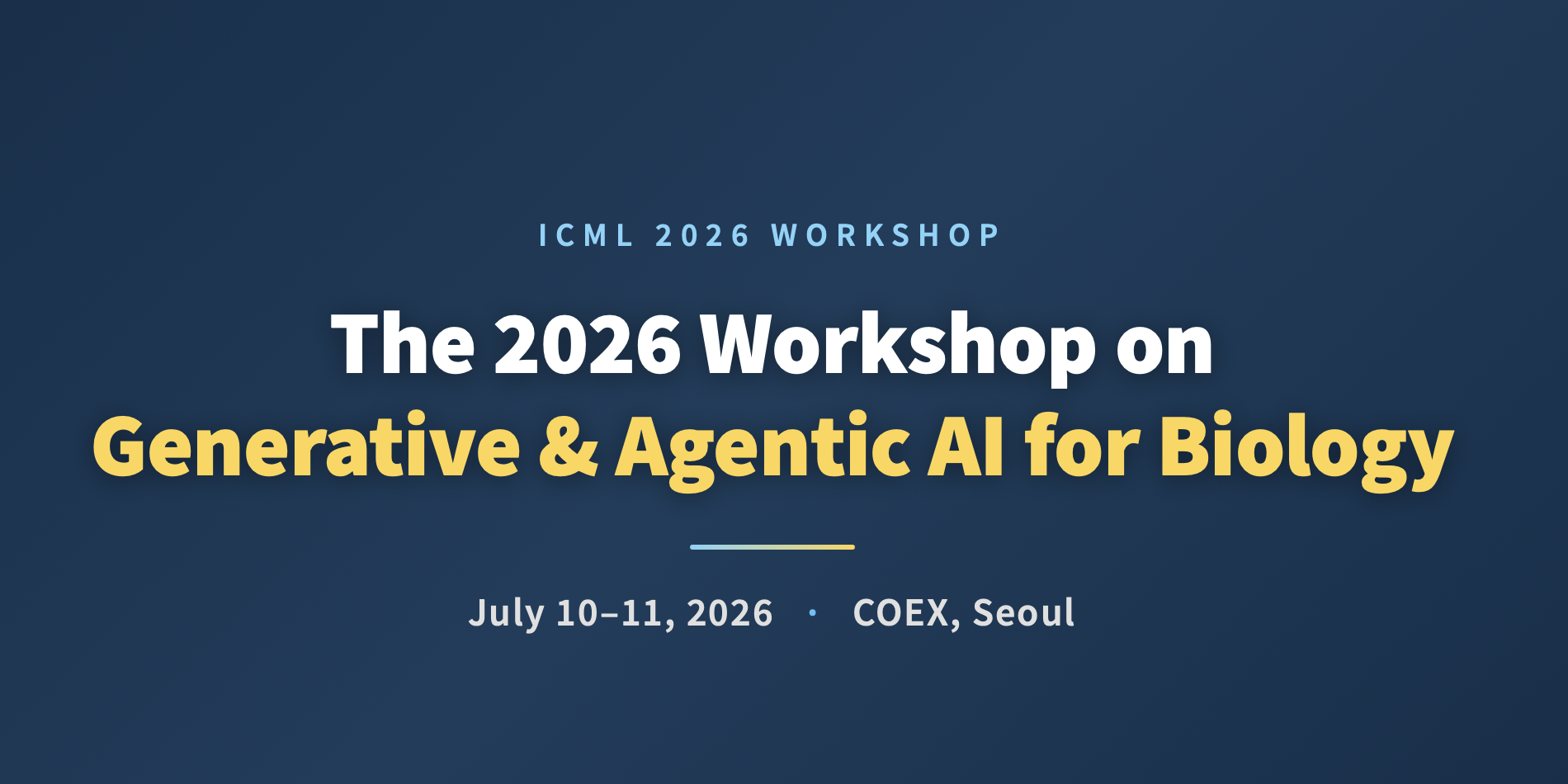
The 2026 Workshop on Generative and Agentic AI for Biology

1783638000000Seoul, South KoreaOfficial workshop site Site reachable

The GenBio 2026 workshop, held in conjunction with ICML 2026 in Seoul, South Korea, explores the intersection of generative AI and agentic systems in biological research. It brings together researchers from machine learning and computational biology to advance AI-driven discovery in biomolecular design, experimental planning, and autonomous scientific reasoning.
Official CFP Back to deadlines Verified September 9, 2026

Paper fit

Contribution paths

A strong submission should clearly identify its contribution and evaluate it appropriately.

Short papers

Up to 4 pages, excluding references and appendices, using the provided LaTeX template.

Long papers

Up to 8 pages, excluding references and appendices, using the provided LaTeX template.

Research areas in scope

01

Generative AI for Biology

Generative ML methods for biomolecular design (small molecules, proteins, RNAs)Generative AI for modeling biological systems (genes, cells, tissues)Novel generative AI algorithms for biological data (sequence, graph, geometric modeling)Foundation models and tools for biological research based on LLMsSequence-based methods (LLMs for protein/genomic sequences)Graph-based methods (molecular graphs, PPI networks, GWAS graphs)Geometric deep learning (biological structures as point clouds, surfaces)From first principles: generative modeling for biological data
02

Agentic AI for Biology

Agent-based systems for hypothesis generation and experimental planningIntegration of AI and experimental biology (closed-loop wet-lab integration)AI-driven predictions with lab-in-the-loop feedbackDesigning and optimizing novel biomolecules (rational protein design, drug design)Next frontiers of de-novo design (peptides, oligonucleotides, antibodies, degraders)Large language models for scientific discovery (literature summarization, hypothesis formulation)Systematic barriers in biological experiment design with GenerativeAI-in-the-loopIdentifying pressing biological challenges beyond traditional methods
03

Foundations and Evaluation

Interpretability of foundation models in biology (knowledge graphs, RAG)Datasets and benchmarks for AI-based biology researchBenchmarks and evaluation frameworks for autonomous scientific systemsHuman-AI collaboration paradigms in biological researchSafety, governance, and ethical considerations of autonomous biological AI systems

Policies worth checking twice

  • Submissions must be anonymous for double-blind review.
  • Submissions are non-archival.
  • ArXiv pre-prints and papers under submission are allowed.
  • Papers presented at the ICML main conference cannot be submitted to this workshop.
  • Authors must indicate conflicts of interest.
  • Supplementary material may be included but reviewers are not required to evaluate it.
  • Maximum submission size is 50 MB.
  • Poster presentations are in-person only.

Official sources

Compiled from the official call for papers. The organizers’ pages remain authoritative.

Last verified September 9, 2026