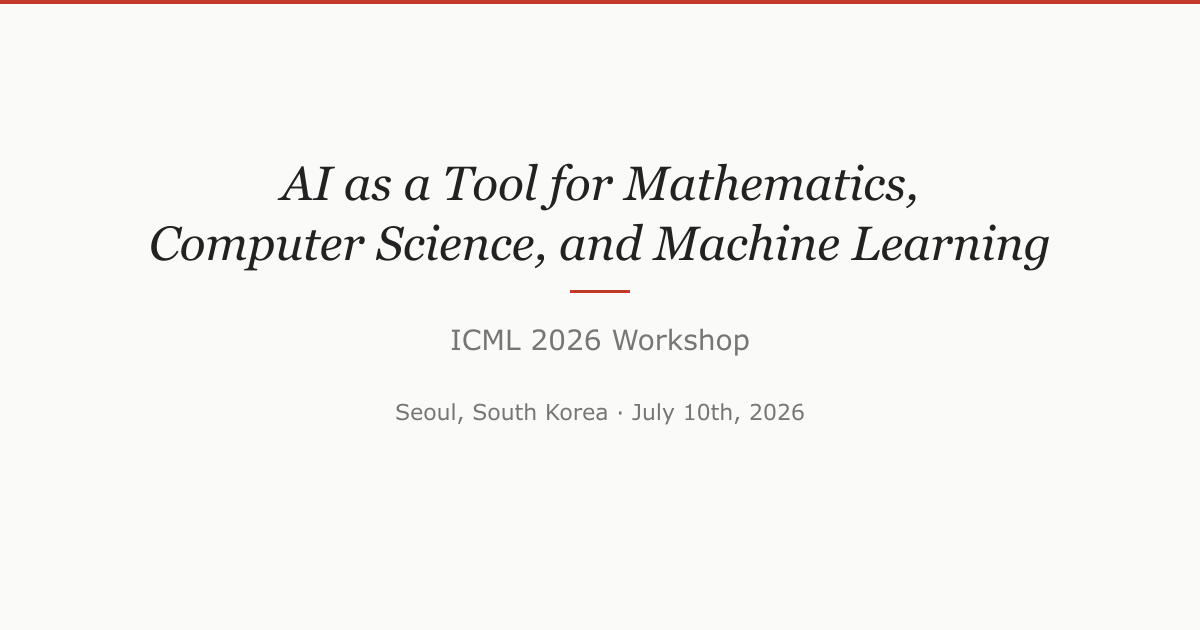
The ICML 2026 workshop 'AI as a Tool for Mathematics, Computer Science, and Machine Learning' focuses on how AI can enhance human research workflows in fields like machine learning, optimization, statistics, and algorithms. It emphasizes reproducible, human-AI collaborative methods—such as prompting strategies, agentic systems, and integration with proof assistants—rather than autonomous AI research, aiming to build a shared community resource of effective AI-assisted research practices.
A strong submission should clearly identify its contribution and evaluate it appropriately.
Full Papers
Up to 4 pages (excluding references), with supplementary material allowed after references; must follow ICML 2026 format; should describe reproducible AI-assisted research workflows with time-savings, performance improvements, and verification methods.
Research areas in scope
01
AI-Assisted Research Workflows
AI-Assisted WorkflowsIterative verification loopsFailure modes and detectionPrompting patterns for correctnessDecomposition and self-critiqueMulti-agent strategiesSwitching from informal to formal reasoningTool-Augmented ReasoningIntegrating LLMs with computation (code, symbolic algebra, numerics)Literature navigationProof assistants (e.g., Lean)Research AccelerationAI for derivationsCounterexample searchExperiment designMethods that transfer across subfieldsAI-assisted research problem formulationAI-assisted experiment design for ML researchSolving mathematical research problems with AI assistanceFormalization and verification workflowsAutomation of iterative loops
Policies worth checking twice
Non-archival: papers published at other venues are welcome
Double-blind review: submissions must be anonymized
Accepted papers will be presented as demos or posters; select papers may be invited for contributed talks
Each submission nominates one author as a reciprocal reviewer
Submissions must be reproducible by ML researchers within a few hours using academic-level resources
Workflows must avoid non-research tasks such as simple writing, basic literature search, slide/poster creation, or pure software engineering
Official sources
Compiled from the official call for papers. The organizers’ pages remain authoritative.