Off-Grid 2026

Deadlines
AI/CORE Unranked

Off-Grid 2026

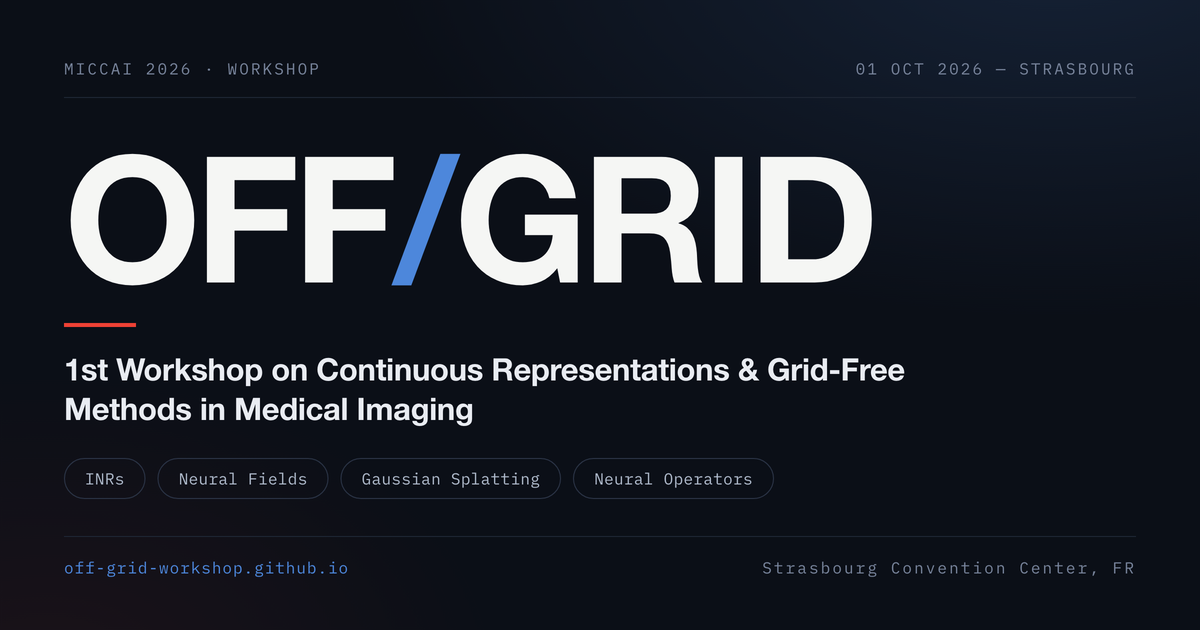
Off-Grid: 1st Workshop on Continuous Representations and Grid-Free Methods in Medical Imaging

Oct 01 2026Strasbourg, FranceOfficial workshop site Site reachable

Off-Grid 2026 is a MICCAI workshop focused on grid-free and continuous representation methods in medical imaging, aiming to move beyond traditional discrete grids to advance medical image computing and computer-assisted intervention. It welcomes research on implicit neural representations, Gaussian splatting, neural compression, and other novel approaches for reconstruction, segmentation, registration, and generative modeling in medical data.
Official CFP Back to deadlines Verified September 9, 2026

Key deadlines

Verified September 9, 2026

Full paper

July 8, 2026

AoE

Workshop timeline

Submission and decisions

Full paperKey deadline

July 8, 2026 · AoE

Paper fit

Contribution paths

A strong submission should clearly identify its contribution and evaluate it appropriately.

Full Paper

8 pages (excluding references, acknowledgments, disclosure of interests) + 2 additional pages for references, acknowledgments and disclosure of interests

Research areas in scope

01

Topics of Interest

Continuous Representations for Medical ModalitiesNeural fields and implicit neural representations for encoding MRI, CT, X-ray, ultrasound, pathology images, endoscopy, and other medical signalsGrid-Free Reconstruction & RenderingNeRFs, Gaussian Splatting, and related techniques for 2D/3D/4D visualization, novel view synthesis, and surface/volume reconstruction of anatomical structuresGeneralization Beyond Single SubjectsGeneralization approaches including autodecoders, hypernetworks, or meta-learning strategiesNeural CompressionNeural compression strategies using implicit representations for high-fidelity storage and transmission of large-scale medical imaging datasetsResolution-Agnostic AnalysisMethods leveraging continuous representations for super-resolution, cross-resolution learning, and handling heterogeneous acquisition protocolsRegistration & Spatial AlignmentContinuous deformation fields and grid-free approaches for image registration across modalities, time points, respiratory/cardiac phases, or subjectsSegmentation & Shape ModelingImplicit surface representations and splat-based methods for anatomical structure segmentation and shape completionSurgical & Interventional ApplicationsReal-time rendering, scene reconstruction, and visualization for surgical planning and navigationGenerative ModelingDiffusion models, GANs, and other generative approaches combined with continuous representations for synthetic medical data generationUncertainty QuantificationMethods for estimating uncertainty in INRs, NeRFs, and Gaussian Splatting for safer deployment in clinical workflowsNeural Operators for Imaging TasksFourier Neural Operators, DeepONets, and related architectures for learning resolution-independent mappings for reconstruction, super-resolution, and inverse problemsPhysics-Informed Neural NetworksPINNs and their application to solving partial differential equations and parameter estimation in medical imaging

Policies worth checking twice

  • All papers must follow the official MICCAI 2026 Paper Submission Guidelines
  • Papers must be formatted using the official MICCAI 2026 LNCS Template
  • All submitted material must be properly anonymized for the double-blind review process
  • Omit acknowledgments and disclosure of interests from submitted manuscripts; include them only in the camera-ready version
  • Supplementary materials are limited to multimedia content (e.g., videos) as warranted by the technical application
  • PDF files may not be submitted as supplementary materials unless authors are citing a paper that has not yet been published (in which case an anonymized version must be submitted)
  • Authors are encouraged to submit anonymized code alongside their paper (e.g., via AnonymousGitHub)
  • Submissions must be entirely original and should not overlap substantially with any work already published or under review

Official sources

Compiled from the official call for papers. The organizers’ pages remain authoritative.

Last verified September 9, 2026