UserSim NeurIPS 2026

Deadlines
Machine Learning/CORE Unranked

UserSim NeurIPS 2026

NeurIPS 2026 Workshop on Grounded User Simulation for Model Evaluation and Training: Diversity, Fidelity, and Validity

Dec 12 2026Paris, FranceOfficial workshop site Site reachable

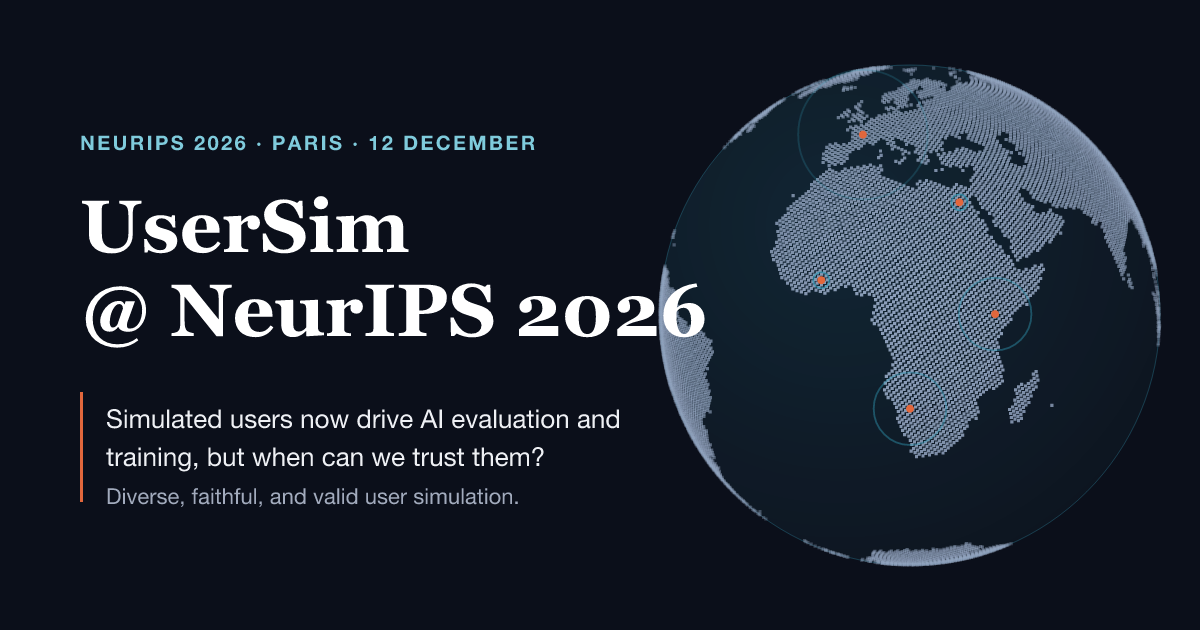
UserSim @ NeurIPS 2026 is a workshop focused on establishing trustworthy, open, and shared user simulation methods for evaluating and training AI systems. It brings together researchers from diverse fields—including agentic evaluation, information retrieval, dialogue systems, and fairness—to address the critical challenges of diversity, fidelity, and validity in simulated user models, with the goal of building community standards and reusable infrastructure.
Official CFP Back to deadlines Verified September 9, 2026

Key deadlines

Verified September 9, 2026

Full paper

September 2, 2026

AoE

Workshop timeline

Submission and decisions

Full paperKey deadline

September 2, 2026 · AoE

Paper fit

Contribution paths

A strong submission should clearly identify its contribution and evaluate it appropriately.

Extended abstract

Non-archival submissions of 4–8 pages, including empirical studies, benchmark proposals, negative results, replications, tools and demos, position papers, and methodological reports.

Short paper

Non-archival submissions of 4–8 pages, including empirical studies, benchmark proposals, negative results, replications, tools and demos, position papers, and methodological reports.

Research areas in scope

01

Diversity

Population grounding and representativenessFairness and demographic, dialectal, and multilingual calibration of simulatorsScenario and goal generation, including coverage of rare and long-tail interactions
02

Fidelity

Behavioral realism and cognitive plausibility of simulated users; the Sim2Real gap and validation against real humansIndividual- and population-level fidelity, including behavioral variation, style, strategy, and consistency over timeControllability and reliability: steering persona and instruction-following, consistency across runs, and simulator failures that invalidate a measurement or a reward signal
03

Validity

Simulator diversityTrain/eval separation and contaminationHuman calibrationLLM-judge auditing
04

Settings and modalities

Agentic and tool-use user simulation; interactive and trajectory-level evaluationVoice and multimodal user simulation: turn-taking, interruption, and full-duplex interactionConversational search, dialogue systems, recommender systems, HCI, and social simulation
05

Training and infrastructure

Simulation for training: SFT, preference optimization, and process-reward data generation; the user simulator as an interactive RL environmentSmall, open, and distilled user simulators, including specialized models rather than prompted ones, that the community can run locallySynthetic-data generation and compound-AI pipelines for building, grounding, and scaling simulators (frameworks, persona datasets)

Policies worth checking twice

  • Submissions must be anonymized for double-blind review
  • Paper length: 4–8 pages, excluding Limitations, Appendix, and References
  • Non-archival: authors retain all rights and may submit to archival venues afterwards
  • Previously published work and work appearing in the NeurIPS 2026 main track are not eligible
  • Preprints (e.g., arXiv) are permitted and do not disqualify submissions
  • Concurrent submissions are permitted, provided the other venue’s policies also allow it
  • At least one author must present in person in Paris to receive a poster or spotlight slot
  • Organizers may not submit papers

Official sources

Compiled from the official call for papers. The organizers’ pages remain authoritative.

Last verified September 9, 2026

UserSim NeurIPS 2026: deadlines, venue, and submission guide | COREXA